
Express.js and Node.js development services we provide
Custom Express.js backend and API development
Metadrop builds net-new back-ends for REST and GraphQL APIs, service layers and integration middleware, on Node.js current LTS with TypeScript from the first commit. Each endpoint ships with an OpenAPI contract and an automated test suite (Jest or Vitest plus Supertest), so the API is documented and verifiable before any consumer depends on it.
API design and architecture review
An independent review of an existing Node.js codebase looks at middleware structure, error handling, data access and N+1 query patterns, the auth model and dependency health. It arrives as a written roadmap with a risk register before any code changes, so the client decides with the technical picture in hand.
Microservices and event-driven services
Service decomposition uses message queues (RabbitMQ, Kafka), containerized delivery on Docker and Kubernetes, and a CI/CD pipeline per service. Health checks, structured logging and metrics endpoints belong to the definition of done from the first release.
Backend-for-frontend (BFF) layers for SPAs
Legacy Node.js modernization and TypeScript migration
Ageing Express 4 patterns and plain JavaScript move incrementally to current Express or NestJS with TypeScript, guarded by tests at every step. The same work covers non-Node legacy back-ends moving to Node.js one endpoint at a time; the modernization section below describes the pattern in detail.
Vendor handover and long-term maintenance
Metadrop takes over existing, sparsely documented Node.js applications. The handover produces a dependency and CVE inventory, architecture documentation and a test-coverage baseline, and the application then moves onto a supported release cadence. Ongoing ownership runs under a contractual SLA: security patching, dependency upgrades, performance tuning and feature evolution.
They've Trusted Metadrop
From humanitarian organizations to industrial manufacturers, international federations and media publishers, organizations across 50+ countries have relied on Metadrop for API, integration and JavaScript platform engineering.






Express or NestJS: the architecture decision, and our stack
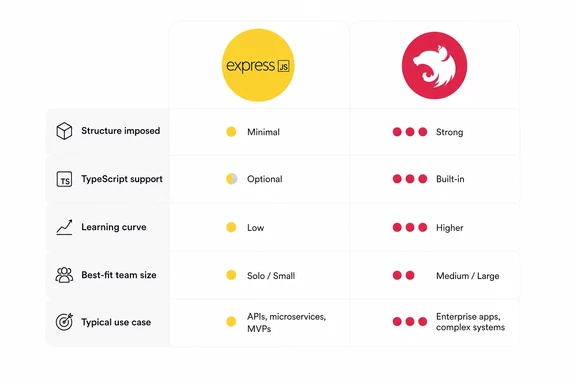
Express is a minimal, unopinionated Node.js web framework. It imposes almost no structure, which makes it fast to start with and means it needs deliberate engineering discipline to stay maintainable at scale. NestJS supplies that structure out of the box through modules, dependency injection, decorators and first-class TypeScript, which suits long-lived services with several teams committing to them.
Metadrop builds both, and makes the choice an explicit, documented decision at project start. Team size, expected service lifetime, governance needs and hiring plans drive it. Where Express is the right fit, Metadrop applies its own conventions layer: a layered project structure, typed request validation with Zod, centralized error handling, versioned routes, and a middleware inventory that stays reviewable.
Express 5 is the current major line, with reworked async error propagation and path matching, and public-interest funding behind its maintenance. That funding matters when you are planning a service expected to run for several years.
- Runtime and frameworks: Node.js current LTS, Express 5, NestJS, TypeScript.
- APIs: REST with OpenAPI, GraphQL with Apollo, WebSocket and Socket.IO for real-time, gRPC where service-to-service latency matters.
- Data: PostgreSQL, MongoDB, Redis; Prisma and TypeORM as ORM layers.
- Messaging and jobs: RabbitMQ, Kafka, BullMQ.
- Testing and quality: Jest, Vitest, Supertest, Playwright for end-to-end, Newman for API contract suites, ESLint and strict TypeScript settings in CI.
- DevOps: Docker, Kubernetes, GitLab CI, GitHub Actions, Jenkins; AWS, Azure and EU-region hosting.
Incremental modernization of a legacy backend
Most legacy back-ends cannot be rewritten in one release. The business depends on them daily, and the original team has usually moved on.
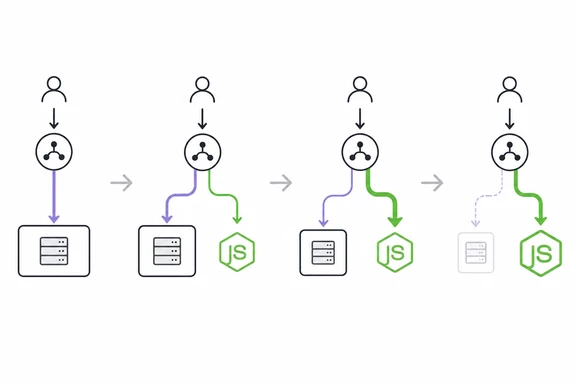
Metadrop applies the strangler pattern: new Express or NestJS services run alongside the legacy back-end behind a gateway or router, and endpoints are retired progressively. Each migrated endpoint is guarded by automated contract tests that assert the new response matches the old one before traffic is switched.
The first phase is an audit and roadmap: an endpoint inventory, a dependency and CVE report, a data-model map, a test-coverage baseline and a prioritized sequence. Typical outcomes are end-of-life dependencies removed, plain JavaScript replaced by TypeScript, a documented OpenAPI surface, and a release process the client's own team can run.
The approach is designed to minimize downtime and keep a rollback path open at each phase, so the platform does not rely on a single cutover date.
A short discovery call maps risk, sequence and a realistic timeline for moving off your legacy backend, before you commit to anything.
Express.js use cases we deliver
REST and GraphQL API back-ends
A single, documented API surface for web, mobile and partner consumers, with versioning, rate limiting and authentication built in.
Microservices and integration middleware
Services that sit between enterprise systems, normalizing data and absorbing the quirks of each vendor API: CRM, ERP, SSO, payment gateways, SharePoint and document stores
Real-time services
Notifications, chat, live dashboards and operational monitors over WebSocket, with Redis-backed fan-out so the service scales horizontally.
Backend-for-frontend for React and Angular applications
One aggregation layer per front-end, so the browser calls a single purpose-shaped API instead of six enterprise systems. API response times and payload size are a measurable part of the front-end experience, including the perceived speed and crawlability of the public-facing pages the marketing team owns.
Public-sector and NGO digital services
Multilingual, high-availability services with audit trails, granular role-based access and EU-region data hosting.
Serverless and edge functions
Short-lived Node handlers on AWS Lambda, Azure Functions or edge runtimes, for webhooks, image pipelines and scheduled jobs where a standing server is unnecessary.
Security, compliance and governance
Secure authentication and authorization
OIDC, OAuth2, JWT and SAML flows, short-lived tokens, refresh rotation, and role- and attribute-based authorization enforced server-side.
Supply-chain and dependency security
Each delivery pipeline runs npm audit, lockfile integrity checks and SBOM generation. Dependency upgrades are scheduled work rather than an emergency response.
GDPR-compliant data handling
Data minimization at the API contract level, lawful-basis mapping for each data flow, retention and deletion endpoints, structured logs scrubbed of personal data, and EU-region hosting where residency matters.
Prepared for NIS2 requirements
A secure SDLC, code review, dependency scanning and a vulnerability-response window defined in the SLA keep delivery prepared for NIS2 obligations in regulated sectors and public bodies. Whether a specific organization is in scope, and what it must evidence, is an interpretation of the regulation and not legal advice.
ENS-certified partner
Metadrop holds Spanish National Security Scheme (ENS) certification, a requirement in Spanish and wider EU public-sector procurement.
Accessibility where there is a user interface
WCAG 2.1 AA is the delivery baseline for any front-end Metadrop builds on top of these services, and 2.1 AA is today's legal accessibility baseline in the EU; WCAG 2.2 AA is applied as a design-quality target. Pure API services have no user interface, so accessibility work is scoped to the interfaces that do.
Independent technical governance
How we work: our delivery process
Discovery and scoping
consumers, data flows, the integration map, non-functional targets and success metrics, agreed before code starts.API contract first
an OpenAPI or GraphQL schema reviewed and signed off, so front-end and back-end teams can build in parallel against a stable contract.Architecture decision record
Express or NestJS, data stores, messaging, hosting and observability choices written down with their trade-offs.Agile delivery in 2-week sprints
a demo, a retrospective and a transparent backlog every sprint. See our methodology.
Quality and security gates
automated tests, contract tests, dependency and CVE scans, and a load test before each release.Launch and continuous improvement
production rollout, monitoring and alerting, performance budgets and ongoing maintenance under a defined SLA.
Engagement models
Dedicated team
A Metadrop squad with a tech lead, senior and mid back-end engineers, QA and a PM, working to the client's roadmap. Best for multi-quarter platform work.
Staff augmentation
Senior Node.js and TypeScript engineers embedded in the in-house team under client management. Best for closing a known skills gap.
Fixed-price project
A scoped deliverable with an agreed budget and timeline. Best for a defined API build, a BFF layer or a bounded modernization phase.
Maintenance and support retainer
A monthly capacity block with response and resolution windows set contractually, covering patching, upgrades and evolution.
Why organizations choose Metadrop for Node.js and Express
Metadrop brings 15+ years of enterprise web engineering, Drupal Silver Certified Partner status and ENS certification, delivering in 50+ countries and 30+ languages. It is a European team working in European time zones, under European data-protection and procurement rules, taking engineering responsibility for the API and integration work it delivers. The full lifecycle sits in one contract: architecture, API design, build, integration, QA and SLA-backed support.
Metadrop's engineers have published on testing and mocking third-party APIs in development and CI environments, the discipline that keeps an integration-heavy backend releasable. Their published work on asynchronous and reactive programming patterns spans multiple generations of Node.js tooling, alongside work on decoupled architectures where JavaScript applications consume API back-ends.
That experience is reflected in recent project work. Metadrop built a GraphQL API with JWT authentication covering CRUD endpoints, group management and invitation-email flows, powering the authenticated member area of a global humanitarian organization working in 50+ countries and consumed by a JavaScript single-page application. It maintains automated REST and GraphQL contract test suites running in CI with Postman and Newman across a multilingual NGO platform and a media publishing platform, so integration regressions surface before release.
For an international sports federation, Metadrop engineered a typed TypeScript API client layer: declarative endpoint definitions, runtime schema validation with Zod, and a repository/adapter architecture feeding 200+ front-end components. It also delivered integration middleware between a public-facing platform and enterprise CRM, SharePoint and payment-gateway systems for a humanitarian organization operating across dozens of countries, and it runs Node 22 and TypeScript build toolchains with containerized dev/CI parity, using Docker multi-stage builds and Jenkins pipelines, on multisite platforms in the media and sports sectors.
Frequently asked questions
What is Express.js used for?
Express.js is a minimal, unopinionated web framework for Node.js, used to build REST and GraphQL APIs, microservices, real-time services and backend-for-frontend layers. It handles routing, middleware and HTTP plumbing, and leaves architecture, validation and structure to the engineering team.
Express.js vs NestJS: which fits an enterprise backend?
Express fits small, focused services and teams that want to assemble their own stack, provided the conventions are set deliberately. NestJS fits long-lived services with multiple contributors, because modules, dependency injection and TypeScript conventions come built in. Metadrop builds both and records the decision, with its trade-offs, in an architecture decision record at project start.
What is a backend-for-frontend (BFF) layer?
A backend service dedicated to one front-end application. It aggregates calls to several enterprise APIs, reshapes payloads for that specific UI, and keeps credentials and tokens on the server. It typically reduces round trips and payload size, and it stops each SPA from re-implementing enterprise integration logic.
How much does Express.js development cost?
Cost depends on the number of endpoints, the integration surface, non-functional targets and the engagement model. Metadrop publishes its engagement models (dedicated team, staff augmentation, fixed price, retainer) and quotes per project after a free consultation, because rates vary by seniority and contract length.How long does it take to build a REST or GraphQL API?
A focused API or BFF layer typically runs 6 to 12 weeks from discovery to production. A multi-service platform or a phased modernization commonly spans 6 to 12 months. The discovery phase produces a project-specific estimate before any commitment.
Can you modernize our legacy Node.js backend without a full rewrite?
Avoiding a rewrite is the goal. New services run beside the legacy back-end behind a gateway (the strangler pattern) and endpoints are retired progressively. Contract tests assert that the new endpoint matches the old response before traffic moves, and each phase keeps a rollback path open.
Is Node.js secure enough for enterprise and public-sector applications?
Node.js runs mission-critical back-ends across sectors, and the risk concentrates in dependencies and configuration rather than the runtime. Metadrop's baseline is npm audit and SBOM generation in CI, lockfile integrity, short-lived OIDC/OAuth2 tokens, server-side authorization, input validation at the contract boundary, secrets management, and a vulnerability-response window set in the SLA. Metadrop is ENS-certified and delivers under GDPR, with delivery practices prepared for NIS2 requirements.
Can you take over an existing Node.js application from another vendor?
Yes, and it is a common starting point. The handover phase produces a dependency and CVE inventory, architecture documentation and a test-coverage baseline before any feature work. After that, the application moves onto a supported release cadence with response and resolution windows defined contractually.
Start your Node backend project with Metadrop
European Node.js and Express engineering: API design, build, modernization and SLA-backed support in one contract.
Tell us about your backend or API and we'll scope a free 30-minute technical consultation, with no commitment required and a reply within one business day.