What Drupal Salesforce integration solves
Manual re-entry between Drupal forms and Salesforce records creates duplicate contacts and delays follow-up, a common bottleneck for teams running the two systems side by side. Leads or donations captured on the site often sit stale until someone manually exports and imports them into Salesforce, slowing sales or fundraising follow-up. Marketing and communications teams lose personalization power when Drupal-side behavior data never reaches Salesforce campaigns.
Metadrop's connectors are designed to close this gap with real-time or scheduled bidirectional sync, so Drupal and Salesforce hold the same record without manual handling.
What we sync between Drupal and Salesforce
Metadrop syncs contacts and leads captured through Drupal webforms, gated content, or e-commerce checkouts into Salesforce Sales or Service Cloud. Donor and member records, including recurring-donation status, sync from Drupal donation and membership flows into Salesforce.
When an organization's data model doesn't fit an off-the-shelf connector, Metadrop maps custom Salesforce objects field by field. The same approach extends to internal stakeholder and partner contact records, not only external donor or customer data, for organizations that also use Salesforce to track institutional relationships from an intranet or portal. Sync direction is configured per field mapping, so an organization can choose which system is authoritative for each data point rather than forcing one-way replication.
Salesforce Nonprofit Cloud & donor data sync for NGOs
Metadrop has synced donor and membership data into Salesforce for humanitarian and social-inclusion organizations, keeping recurring-donation status and constituent records current between Drupal and Salesforce. Connectors are designed to work alongside Salesforce Nonprofit Cloud field structures (donations, opportunities, affiliations), mapped to the equivalent Drupal donation and membership entities.
Where an organization also runs a constituent-management system alongside Salesforce, Metadrop has built parallel synchronization so both systems reflect the same donor activity without duplicate entry. Data flows are designed to support GDPR requirements in transit and at rest, a relevant safeguard given the sensitivity of donor and beneficiary data NGOs handle.
How we build your Salesforce connector
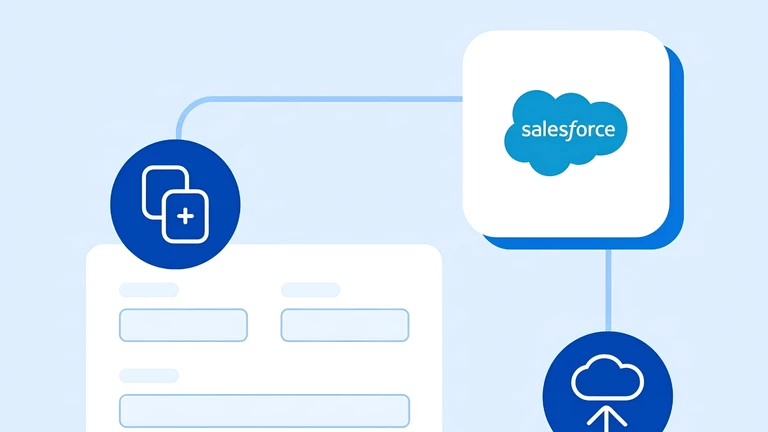
Metadrop starts with discovery, mapping the Salesforce objects, Drupal entities, and authentication model before writing any code. Most connections authenticate through OAuth or JWT, the mechanism most Salesforce integrations rely on, with credentials stored via Drupal's Key module rather than hard-coded into settings files.
Connectors are typically built on Drupal's established Salesforce Suite module ecosystem, extended with custom entities and field mappings when an organization's data model goes beyond the standard schema. Field-mapping and test cycles validate sync behavior against sample records before any connector reaches production data, and the integration is designed to layer onto the live Drupal site without disrupting existing content, URLs, or SEO rankings. Connectors work equally with a fully headless Drupal front end or a traditional coupled site.
Security, compliance & code ownership
Every Salesforce data flow is designed to support GDPR requirements in transit and at rest. Metadrop applies OWASP secure-coding practices and least-privilege API credentials to every connector.
Your team owns the code and the IP: Metadrop delivers each integration as a standard, documented Drupal module, not something held behind a proprietary platform. This approach suits compliance-driven sectors, including public sector, NGO, and regulated enterprise, where donor, beneficiary, or customer data protection is a contractual requirement. Sensitive internal or partner data synced from an intranet is handled under the same GDPR and least-privilege model as external customer or donor data.
Why organizations trust Metadrop for Salesforce integrations
Metadrop brings 15+ years of Drupal expertise as a Drupal Silver Certified Partner, with hands-on Salesforce connector delivery spanning NGO donor-management and enterprise marketing-automation projects across 50+ countries.
A multinational specialty-chemicals manufacturer's Drupal sites route marketing-qualified leads into Salesforce Pardot, rebuilt around a webform-handler approach that gives the marketing team native control over form design and lead capture. A global engineering and technology company in the energy sector runs the same Pardot-to-Salesforce pattern across its corporate site, with submission data reaching Salesforce alongside analytics events. A multinational specialty-food manufacturer's Drupal platform consolidates four separate Salesforce products (CRM, Identity, Marketing Cloud, and a loyalty/gamification layer) into one customer experience, syncing registration, profile, and loyalty data.
This work sits alongside Metadrop's ENS certification and GDPR compliance track record, which apply across its regulated-sector engagements.
They've Trusted Metadrop
From humanitarian nonprofits to multinational manufacturers, organizations across Europe and beyond have relied on Metadrop to keep Salesforce and Drupal data flowing reliably.







Drupal Salesforce integration FAQ
What is Drupal Salesforce integration?
A Drupal Salesforce connector syncs records (contacts, leads, donor or member data, or custom objects) between a Drupal site and a Salesforce org, in one or both directions. Metadrop builds it as a Drupal module using Salesforce's REST or Bulk API, rather than a manual export/import process.Which Drupal module powers a Salesforce connection?
Most implementations build on the Drupal ecosystem's Salesforce Suite module, which handles authentication and object mapping over Salesforce's REST API. Custom entities and field mappings are added on top when an organization's Salesforce schema goes beyond the module's defaults.
Does the sync run in both directions?
Sync direction is configured per field mapping, so a record created in Drupal can push to Salesforce, and a Salesforce update can pull back into Drupal. Which system is authoritative for a given field is a scoping decision made during discovery, not a fixed default.
Is a Drupal Salesforce integration GDPR-compliant?
Data flows are designed to support GDPR requirements in transit and at rest, with least-privilege API credentials for every connector. Specific compliance obligations depend on the data processed and the organization's own GDPR posture. This is a technical design practice, not a legal opinion.How long does a Drupal Salesforce integration take?
Most single-object connectors, such as leads or contacts only, run several weeks after discovery; multi-object or Nonprofit Cloud donor-sync projects take longer. Metadrop gives a fixed-scope estimate once the Salesforce objects and Drupal data model are mapped.Can Salesforce Nonprofit Cloud donor and member data sync with Drupal?
Yes, donor, membership, and recurring-donation data can sync between Drupal donation flows and Salesforce Nonprofit Cloud's donation and affiliation objects. Metadrop has delivered this pattern for humanitarian and social-inclusion organizations, alongside parallel constituent-management systems where applicable.Who owns the integration code once it's built?
The client does. Metadrop delivers the connector as a standard, documented Drupal module, maintainable by an in-house team or any Drupal partner. No part of the integration is held behind a proprietary platform or vendor-only tooling.