

What managed Acquia Cloud hosting for Drupal covers
Acquia Cloud is a platform-as-a-service built specifically for Drupal: infrastructure, caching, search and deployment tooling shaped around Drupal rather than around generic PHP. Managed Acquia hosting means an operating partner runs that platform, covering provisioning, deployments, monitoring, platform patching, scaling and incident response.
Acquia sits in a different category from generic web hosting. Shared web hosting, static tiers and a specialized Drupal PaaS are three different markets with different cost and obligation profiles, so comparing a monthly web-hosting price against an Acquia subscription compares two unlike things.
One further distinction settles most scoping conversations: Acquia Cloud Platform, Acquia Cloud Site Factory and Acquia Search are separately contracted products. A Cloud Platform subscription does not include the Site Factory site-creation workflow, and search capability depends on which product is contracted, so confirm what your organization actually holds before anything gets scoped on top of it. Metadrop's role is the operating layer on top of whichever Acquia products are contracted, with one team accountable for platform operations, performance and search.
Weighing managed PaaS against infrastructure you control? Compare with self-hosted Drupal infrastructure.
They've Trusted Metadrop
From industrial manufacturing and chemicals to energy and food, organizations operating across European and global markets have relied on Metadrop for Drupal platform operations on Acquia and other managed clouds.








Working with an Acquia Bronze Level Partner
Metadrop is an Acquia Bronze Level Partner, a Drupal Association Silver Certified Partner, and a partner of Upsun. Behind that sit 15+ years of Drupal delivery and platforms operated for organizations across 50+ countries and 30+ languages. Metadrop is also ENS certified (Spain's Esquema Nacional de Seguridad, Categoría Media) and holds ISO 9001 and ISO 14001, which are credentials rather than assurances, and mandatory for public-sector work.
Independent technical governance comes with the engagement: Metadrop holds and argues a position on architecture and platform choice, and explains the risk in business terms for the members of the buying group who will not read the code. That includes saying when Acquia is the wrong answer. Metadrop has moved a Drupal platform off Acquia onto an alternative managed PaaS for cost and deployment-flexibility reasons, so the comparison across managed Drupal PaaS providers is informed by practical delivery experience.
Who this service fits
The service fits organizations already on Acquia Cloud whose current operator is not delivering stability: recurring incidents, unpredictable response, no one accountable when it matters. It also fits teams evaluating Acquia for a business-critical Drupal platform with multilingual, multisite or high-traffic requirements and no in-house DevOps capacity, and organizations under GDPR, WCAG, NIS2 or ENS obligations that need the platform's compliance posture documented rather than assumed. Multisite and multibrand estates, where one code base has to serve many markets under central governance, are the other common case.
It is a weaker fit for a single brochure site with no integrations, no compliance obligation and no traffic peaks. Acquia's cost profile is built for a heavier job than that.
What Metadrop operates on your Acquia platform
Infrastructure and platform configuration live as code wherever the Acquia product exposes it, held in a repository the client owns, so nothing that matters lives only in a console and someone's memory. Changes reach production through controlled promotion up the environment ladder: validated in the least critical environment first, with destructive actions forbidden in production. Platform software maintenance runs on a monthly baseline, and immediately when a critical CVE is disclosed.
Incident response starts from provider-native alarms plus Metadrop's own monitoring, then moves through triage, mitigation and resolution under the agreed SLA, and closes with a post-incident review that produces concrete preventive changes. Backups are verified rather than merely configured: periodic restore testing in an isolated environment, plus a check that the configured retention meets the agreed recovery objectives. Certificate and secret rotation is automated wherever the platform supports it, with credential values kept outside the codebase.
Two habits close the loop each month. Cost review is periodic rightsizing and unused-resource analysis, presented as recommendations prioritized by impact; the client decides, Metadrop implements what is approved. Monthly reporting covers platform health, changes applied, incidents and cost trend.
Application-level Drupal work, meaning core and module updates, bug fixing and new features, is a separate and separately priced service line: Drupal maintenance & support. The two are usually bought together.
Who owns what on your Acquia account
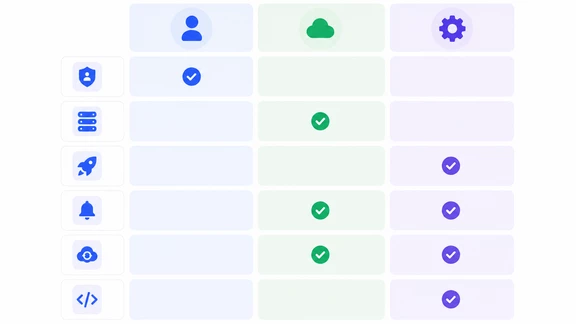
The client owns the Acquia account, contracts Acquia directly and pays Acquia directly. Metadrop operates the platform on it. There is no hosting resale and no margin on infrastructure, which is why the client sees their real platform cost, and why cost optimization can be a service line instead of a conflict of interest. If the relationship ends, the client keeps the account, the data and the infrastructure code, so there is no technical dependency on Metadrop to exit.
Responsibility is agreed in writing as a RACI matrix before the first change ships. Metadrop holds the operational work; the client is consulted on the two decisions that are theirs, namely what the platform should do and what it should cost. Single-invoice arrangements are possible but not the default. Where a client requires Metadrop to front the Acquia bill, the conditions belong in the contract: pass-through at cost, vendor price increases passed on with notice, and usage-based charges such as page views, egress and storage growth following the client's own traffic.
Three things sit outside the scope, stated up front: Acquia's own bill; migrating off Acquia later, which is a new infrastructure-as-code project with its own budget rather than a configuration change; and any uncapped availability promise. What is committed is the response and resolution SLA plus a documented, agreed architecture.
Support runs in two separate layers. Acquia operates the platform layer continuously under the client's own subscription terms. Metadrop's commitment covers the application and operations layer on top of it. In contract terms, that commitment is Level 3 support, where the client and their users reach the engineer who does the work with no escalation chain; incident response during working hours; same-day initial response and triage for critical incidents; a direct emergency phone line to the Tech Lead; and a dedicated communication channel opened per incident with real-time updates. Where a permanent fix is complex, the priority is a working workaround first, so the critical business process keeps running, with the root-cause fix and a regression test following.
What Acquia hosting costs, and how we size it
PaaS cost is driven by resource sizing and traffic, not by the number of sites. A three-site multisite on moderate traffic can cost less to run than a single site under campaign load.
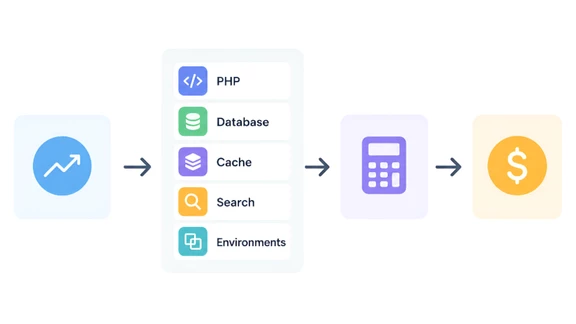
The variables that actually move the number are traffic and metered page-view consumption, the number of environments, which Acquia products are contracted (Cloud Platform, Site Factory, Acquia Search), the vendor support tier, per-user licences on the organization, storage growth, and any CDN or WAF layer in front of the platform. Developer and operations time belongs in total cost as well, not as a footnote to the subscription: an unmanaged platform moves that cost onto internal engineers rather than removing it.
How Metadrop produces an estimate: agree a stated traffic baseline, size the components against it, then run that sizing through the provider's current calculator and present the output as the client's own cost. Metadrop does not publish an Acquia rate, and does not reuse a figure from a previous proposal. Vendor per-resource pricing, support tiers and discounts change, and so does the client's traffic, so an old number is an anecdote rather than an estimate.
Page-view consumption is a cost control, not only a metric. Monitoring subscription consumption and mitigating bot traffic keeps overage off the invoice.



Performance, search and platform upgrades on Acquia
Acquia Search and Solr at scale
Acquia Search is Acquia's managed Solr service, wired to Drupal through the Acquia Connector. Index configuration and language handling are what make it usable on a large multilingual catalogue. Search and SEO intersect on faceted search, where the way facet URLs are exposed and crawled decides whether search pages help organic visibility or dilute it. Acquia's own managed-search offering has moved to SearchStax, so an Acquia Search estate eventually needs that transition planned rather than discovered.
Metadrop has published technical write-ups on a Solr 9 upgrade performed on an Acquia platform and on migrating Drupal from MySQL 5.7 to MySQL 8, the same upgrade categories Acquia mandates on its own calendar. For search architecture beyond the Acquia product, see Solr & Elasticsearch for Drupal.
Caching and cache invalidation
Acquia Purge drives invalidation on Acquia's Varnish layer, so a content change clears the right cached objects instead of the whole site. Per-domain invalidation matters on multisite and multi-brand estates, where one code base serves many hostnames. Memcache and Drupal cache-backend tuning goes on top of the platform defaults, because Acquia's baseline is a starting point rather than a tuned configuration.
Platform-mandated technology upgrades
On a specialized PaaS, the provider's roadmap becomes yours: Acquia retires end-of-life service versions on its own calendar, and the platform has to follow.
Metadrop has operated Acquia Cloud hosting for a multi-brand corporate group's site portfolio, combining Acquia Search, Acquia Purge cache invalidation and a CDN layer in front of the platform, alongside a WCAG AA accessibility commitment. For an energy-sector client on Acquia, it performed platform-mandated technology upgrades: a MySQL 8 migration driven by Acquia's end-of-life of MySQL 5.7, a Solr 9 core upgrade, and a migration from Acquia Search to SearchStax. On an Acquia-hosted enterprise multisite, it replaced Acquia BLT with a DDEV-based local environment as part of a broader stack simplification.
Acquia Cloud Site Factory and multisite estates
Acquia Cloud Site Factory governs many Drupal sites from shared code, with central updates and per-site configuration. It is the "one code base, many sites" model, and it is contracted separately from Cloud Platform.
Site Factory earns its cost on dozens or hundreds of sites, repeated site launches, and central governance across brands or markets. A small fixed estate is usually better served by plain Cloud Platform with a Drupal multisite. The harder Site Factory operations are carve-outs and consolidations: splitting a shared estate into an independent platform, or folding fragmented sites into one.
Metadrop has built and operated an Acquia Cloud Site Factory multisite platform for a global chemicals and materials group, including standing up an independent multisite deployment for a corporate spin-off entity. The architecture behind these estates is covered in Drupal multisite.

Security, compliance and EU data residency
Platform-level controls come with Acquia: WAF, DDoS mitigation, TLS and continuous platform security monitoring. What Metadrop adds on top is access control review, sanitized non-production environments, change tracking, and secret values kept outside the codebase.
GDPR, WCAG and NIS2 obligations are translated into engineering work. WCAG 2.1 AA is the legal baseline for European public-sector and in-scope private platforms today; Metadrop scopes to it and can design beyond it. On NIS2, platforms in scope face documented security-management and incident-reporting requirements, and an unmanaged platform can place an in-scope organization in breach, which is an interpretation of the regime rather than legal advice. What Metadrop delivers is the technical translation.
Metadrop is ENS certified (Categoría Media, RD 311/2022), which is mandatory for Spanish public-sector work and its providers, and a framework that incorporates GDPR principles. EU data residency is a configuration decision: hosting region, backup location and log retention chosen so data stays in the required jurisdiction.

Moving to Acquia, or taking over an existing platform
A platform reaches us by one of two routes, and they carry different risks. A migration moves an existing Drupal site onto Acquia, where the work is largely known in advance and the exposure concentrates in a single cutover window. A takeover leaves the platform where it runs and changes who operates it, so nothing moves and the risk sits instead in whatever was never documented. Both routes open with an audit; which one applies decides what gets planned first. For broader platform and CMS moves, see migrate to Drupal.
Migrating a Drupal platform onto Acquia
The method is designed to minimize data loss and service disruption, and the schedule, rollback point and success criteria are agreed before cutover rather than assumed.
Planning and replication
a full audit of codebase, database and files, then a complete replica built on Acquia. Testing runs against the replica, with no impact on the live site.Final sync with a data lock
in a planned low-traffic window, a final synchronization runs while the original site is placed in read-only mode. Skipping the lock is how content, form submissions and registrations get lost during the sync window.
Coordinated go-live
the DNS change is executed jointly with the client's team, and the launch is monitored rather than announced and forgotten.
Taking over an Acquia platform someone else runs
In a takeover no data moves, but the unknowns are larger: the risk sits in undocumented configuration rather than in the migration itself. Four prerequisites are stated as conditions rather than requests: a complete handover workshop rather than a credential handoff; a working, stable platform at the point of transfer; a joint deficiency review with the outgoing provider, which is the cheapest audit on offer and only possible during handover; and no structural changes in the first months, so the platform is stabilized and understood before anything is rebuilt. Where its current state is unknown, an infrastructure audit answers that question more cheaply than a rebuild.
Metadrop has delivered a Drupal 11 upgrade on a large enterprise multisite hosted on Acquia, completed without reported service disruption, alongside migrating the platform's search off Acquia-hosted Solr.
Whether you are migrating onto Acquia or handing over a platform that keeps breaking, the first step is the same short scoping conversation.
Frequently asked questions
How much does Acquia hosting cost?
Acquia hosting cost is set by resource sizing and traffic rather than by a list price, so the same site costs differently at different traffic levels. The variables to price are traffic and metered page views, environment count, which Acquia products are contracted, support tier, organization user licences and storage. Metadrop sizes the platform against a stated traffic baseline, runs it through the provider's current calculator, and presents the Acquia subscription and the operations fee as two separate lines, since the client pays Acquia directly.Can we migrate an existing Drupal site to Acquia Cloud?
Migrating an existing Drupal site to Acquia Cloud is a three-phase exercise: a replica and testing, a final sync with the origin in read-only mode, then a coordinated go-live. The read-only window is what protects content and form submissions created during the sync. The method is designed to minimize data loss and downtime, and the rollback point and success criteria are agreed before cutoverWhat is the difference between Acquia Cloud Platform and Acquia Cloud Site Factory?
Acquia Cloud Platform and Acquia Cloud Site Factory are separately contracted products. Cloud Platform hosts and deploys a Drupal codebase, while Site Factory adds governed site creation and per-site configuration across many sites from shared code. A Cloud Platform subscription does not include the Site Factory workflow, so "we are on Acquia" does not settle whether the multisite tooling is available. Metadrop operates both, and will say which one a given estate actually needs before it is contracted.
Does Metadrop work with Acquia Search and Solr?
Acquia Search is Acquia's managed Solr service, connected to Drupal through the Acquia Connector, and Metadrop configures and operates it on multilingual estates. That work regularly includes Solr core upgrades, index and language configuration, and faceted-search behavior that affects crawlability. Acquia's managed search offering has moved to SearchStax, and Metadrop has performed that transition on a production Acquia platform.
Does Acquia hosting meet GDPR, NIS2 and ENS requirements?
Acquia hosting provides platform-level security controls and EU hosting regions, but compliance is a property of the whole platform rather than of the hosting alone. Metadrop configures data residency, access control, retention and audit trails so the obligations are documented and evidenced. GDPR, NIS2 and ENS readiness is delivered as a technical translation of the requirements, which is an interpretation of the regimes rather than legal advice.
Who owns the Acquia account and the code?
The client owns the Acquia account, contracts and pays Acquia directly, and owns the repository holding the infrastructure definition and the Drupal codebase. Metadrop takes no margin on infrastructure and resells no hosting. If the engagement ends, the account, data and code stay with the client, so exiting is a commercial decision rather than a technical one.
Can Metadrop take over an Acquia platform another provider runs?
Taking over an Acquia platform from another provider is a standard engagement, conditioned on a full handover workshop, a stable platform at transfer, a joint deficiency review with the outgoing provider, and no structural changes in the first months. The notice period on the current contract usually sets the timeline, not the technical work. Where documentation is thin, an infrastructure audit establishes the platform's current state before anything is changed.
Talk to us about your Acquia platform
Talk to us about your Acquia platform
Tell us the platform you run today, the Acquia products in play and a rough traffic baseline. We come back with a scoped operating proposal and, where relevant, a migration or takeover plan.
There is no commitment and no obligation to proceed: the scoping conversation is free, we reply within one business day, and what you send is covered by our privacy policy.