
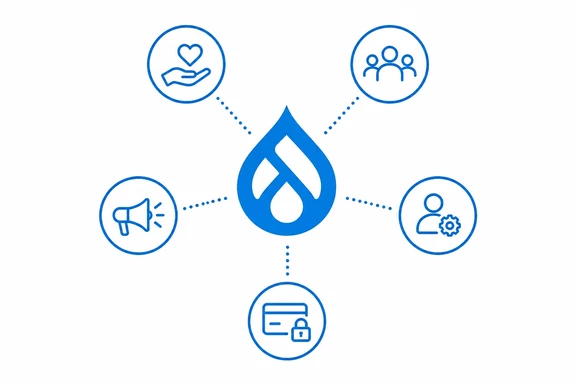
What is a Drupal donation platform for NGOs?
A Drupal donation platform is a single system that runs donation processing, membership sign-up, campaign pages and donor-CRM sync together, rather than stitching together separate tools for each of those jobs.
It's built for organizations that see traffic and giving spikes tied to appeals or crises: pages and payment flows are designed to stay responsive under that kind of surge, not just under steady, predictable traffic. As the number of donors, campaigns and languages grows, the platform often scales by configuration rather than requiring a rebuild, backed by Drupal's open-source ecosystem of 2,500+ contributed modules and 100,000+ active contributors.
The platform covers the full donor lifecycle under one content model: one-time and recurring donations, memberships, petitions and signatures, and crowdfunding, instead of four disconnected products. Editors manage campaign landing pages and donation forms through configurable, no-code form fields, so a new appeal doesn't have to wait on a developer queue.
The cost of disconnected donor systems
Manual data entry between separate donation, membership and CRM tools introduces errors and costs staff time that could go toward programs instead of admin work. A donation page that can't handle a traffic spike during an appeal or crisis risks losing donors at the exact moment giving intent is highest, and a complex or slow checkout flow, or unclear data-security practices, is a common reason potential donors abandon a donation form before completing it.
Campaign teams also need to launch a new landing page or signature drive without waiting on a developer queue; every time an appeal needs a new page, that dependency slows the response.
They've Trusted Metadrop
From child-protection and humanitarian-relief organizations to cancer-research and migrant-inclusion nonprofits, organizations across Europe have relied on Metadrop for donation, membership, and campaign platforms.



What our partners say
A nonprofit partner reflects on working with Metadrop as a technology and fundraising-platform partner.
Fundraising and donations built to convert
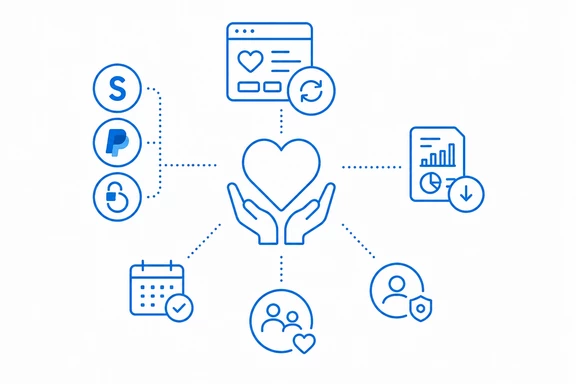
The platform accepts one-time and recurring donations through Stripe, PayPal, and Redsys, so donors can give using the payment method they already trust. Recurring and subscription donation forms support multiple active subscriptions per donor and handle cancellation and renewal periods without manual finance-team intervention.
Donation and campaign data is exportable on demand, so fundraising teams can report on results and donor lists without pulling in a developer. A subscription-donation flow built on Drupal Commerce with Stripe payment sync, for a GDPR-focused humanitarian client, has run in production since 2025, one indicator of the platform's maturity for recurring giving at scale. Guest checkout is supported alongside account-based giving, reducing friction for one-time donors who'd rather not register.
Memberships, campaigns and crowdfunding that grow your community
Customizable membership enrollment forms let new members choose their contribution level, and export as full member lists for finance and outreach teams. Signature and petition campaigns run on fully configurable landing pages, with each data-collection form's fields and required-status set per campaign rather than hard-coded. Crowdfunding tools let individual supporters create their own personalized fundraising pages for a cause, shareable directly to social platforms to extend organic reach.
One migrant-inclusion NGO's platform combines donation and crowdfunding features on Drupal Commerce alongside a 50-plus component content library, letting non-technical editors assemble new campaign pages themselves. A large humanitarian organization's member portal generates dynamic, personalized pages based on a supporter's donation and membership status, pulled live from CRM data.
CRM integrations and donor data that stay in sync
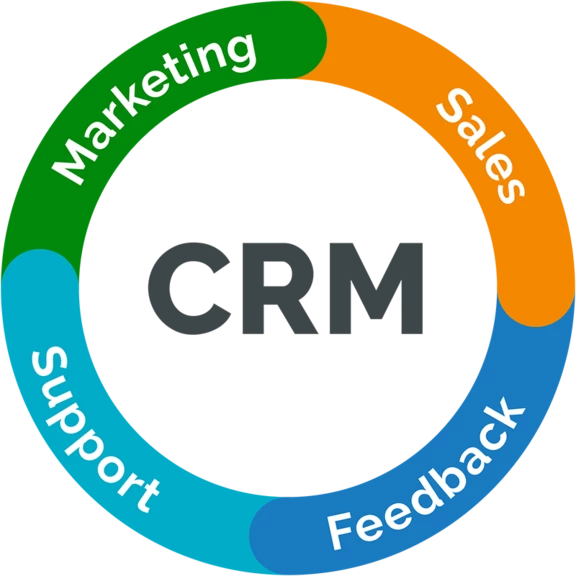
The platform syncs donations, memberships, and signatures with Salesforce, MS Dynamics, or CiviCRM, helping keep donor records consistent across fundraising and back-office systems. Members and donors can update their own contact and contribution details directly on the site, with changes reflected back to the connected CRM.
Because the platform is built on open-source Drupal, your organization owns the platform and its donor data outright, with no proprietary license tying your donor database to a single vendor's platform. One humanitarian organization's Salesforce integration synchronizes an intermediate data layer across two separate systems, keeping donor and membership records aligned without duplicate manual entry. Mailchimp and similar email platforms connect for donor and member newsletter communication without a separate data-export step.
See Module development & third-party integrations for how CRM and payment connectors are built and maintained, and Digital sovereignty for the data-ownership case behind an open-source platform.
Security, GDPR compliance and multilingual reach
Donor data handling is designed to align with GDPR, including cookie-consent configuration that only activates analytics tracking once a visitor has given consent. Sensitive donor and supporter data can be handled with field-level encryption and data-sanitization routines, reducing exposure if a lower environment is compromised.
Metadrop is a Drupal Silver Certified Partner and holds ENS (Esquema Nacional de Seguridad) certification, grounding the platform's security posture in an external, audited standard rather than a self-declared one. Multilingual campaigns run natively: one platform can serve donors in 3+ languages (Spanish, English, French, Catalan, for example) from a single content architecture, with new languages added by configuration.
Analytics (Google Analytics or Matomo) run through a Google Tag Manager setup with a consent-gated data layer, so campaign performance tracking doesn't come at the expense of privacy compliance. WCAG-aligned accessibility patterns are available for donor-facing forms; see Accessibility audits if compliance with public-sector or funder accessibility requirements matters for your organization.
Why nonprofits choose Metadrop as their Drupal partner
Metadrop has 15+ years of Drupal delivery, including long-running engagements with humanitarian and social-cause organizations still in production today. It's a Drupal Silver Certified Partner, with technical governance and security practices audited against the ENS standard, and it works across the full lifecycle: strategy, development, integration, and ongoing maintenance and evolution, with the same team that builds the platform keeping it running afterward.
The track record spans multiple humanitarian, child-protection, and social-inclusion organizations, with platforms in continuous operation for a decade or more in some cases, plus international delivery experience across 50+ countries and 30+ languages, relevant to NGOs running multi-market or multi-language fundraising. That includes independent technical governance: Metadrop advises on platform architecture and risk, which matters for an organization with no in-house Drupal expertise.
Frequently asked questions
Can we set up recurring donations on our nonprofit website?
Yes. Recurring and subscription donation forms are built on Drupal Commerce, supporting multiple active subscriptions per donor and handling cancellation and renewal periods automatically. A subscription-donation flow of this kind has been running in production for a humanitarian client since 2025, synced to their CRM for reporting.
How does Drupal compare to WordPress for a nonprofit donation website?
Drupal's entity and permissions model is designed for complex donor and member permissioning at scale, covering multiple roles, multi-brand or multi-country sites, and granular access rules, which typically requires more custom plugin work in WordPress. One nonprofit migrated from WordPress to Drupal specifically to gain the flexibility and custom program functionality their donation and membership workflows needed. Both are open source with no licensing fee; the difference is how much of the CRM, commerce, and compliance functionality is available natively versus needing extra plugins.
How do you handle GDPR compliance for donor data?
Donor data collection is designed to align with GDPR, including consent-gated analytics and configurable data-retention rules. This is a technical implementation, not a legal opinion, so your organization's own data-processing agreements still govern compliance. Sensitive fields can be encrypted and sanitized in lower environments, reducing the exposure window if a non-production environment is ever compromised.
How long does it take to build a Drupal fundraising platform?
Timeline depends on scope: a focused donation-and-membership build runs on a shorter timeline than a full corporate site with a private member area and multiple integrations. A typical engagement follows discovery, build, and launch phases, with the same team continuing maintenance and feature evolution after go-live; several NGO partners have been in continuous, multi-year engagements rather than one-off projects.What does a Drupal donation platform typically cost?
Cost scales with the number of integrations (CRM, payment gateways, analytics), campaign complexity, and multilingual scope, rather than a fixed platform fee. Because the Drupal core is open source, there's no licensing cost, so budget goes toward configuration, integrations, and ongoing support instead. A free consultation and tailored proposal is the starting point for a project-specific estimate, rather than a published price list.Which Drupal modules power donation and membership features?
Drupal Commerce (with recurring-payment support) handles one-time and subscription donations, and Webform handles campaign, petition, and signature data capture. CRM connectors for Salesforce, MS Dynamics, or CiviCRM keep donation and membership data synchronized with your existing constituent database.