
One framework, multiple sites, endless scale
For a multinational brand, a university, or a global NGO, managing dozens or hundreds of websites without a shared architecture tends to become chaotic and expensive fast. A Drupal multisite platform centralizes what should be common (core, modules, the design system) while keeping what shouldn't be shared (content, local branding, editorial workflows) independent per site.
This approach is built for organizations that need both consistency and scale across a large network of sites, not a one-size-fits-all template. Whether you're consolidating five existing sites or planning for 500 or more, the underlying architecture is designed to scale without requiring a rebuild at every growth stage.
They've Trusted Metadrop
From chemical multinationals to global manufacturers and international associations, organizations managing brand, regional, and departmental site networks across Europe and beyond have relied on Metadrop for Drupal multisite architecture.







What clients say about working with Metadrop
Direct feedback from teams who moved their site networks onto a governed Drupal multisite platform.
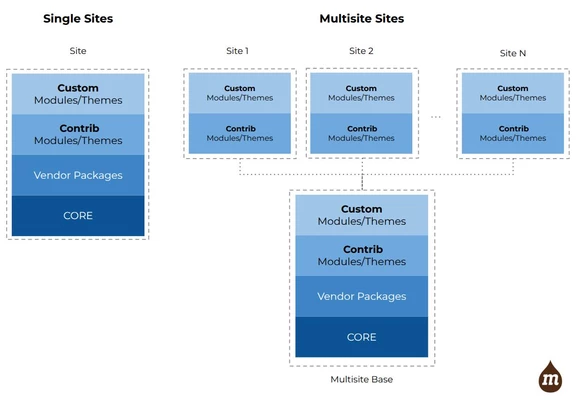
Drupal Mutisite Architecture
What is a Drupal multisite?
A Drupal multisite architecture runs multiple independent websites from one shared codebase. Each site gets its own database and configuration, while all sites share the same Drupal core, contributed modules, custom code, and theme and design-system layer.
In practice, each site lives in its own sites/ directory pointing at the shared codebase, the mechanism Drupal core itself provides for multisite installs. This structure is designed to scale from a handful of sites to 500 or more without duplicating the underlying build.
Metadrop has applied this architecture across sectors, from five-site brand networks to publishing platforms running 500 or more sites, spanning organizations in 50+ countries.
Why choose a Drupal multisite architecture
Centralized governance standardizes branding, shared modules, and workflows across every site from one place, while local teams keep control of their own content. Departmental and regional autonomy runs alongside it: local teams manage their own content and users, while central governance keeps control over shared components, compliance, and design standards.
Drupal's native translation system is multilingual by design, supporting content in dozens of languages, whether per site or shared across the network. On the security and compliance side, core and module updates apply centrally, and every site can align with GDPR, WCAG, and HIPAA-relevant requirements from one governance model rather than site by site. Metadrop is a Drupal Silver Certified Partner and ENS certified, with 15+ years of Drupal-specific delivery experience behind every multisite build.
Shared caching, CDN integration, and DevOps-friendly configuration keep the operational load of running many sites in check. Left ungoverned, growing site networks tend to accumulate codebase drift, inconsistent patching, and fragmented branding over time; a shared multisite codebase is designed to reduce the risk of each of these by keeping only the parts that should stay common centralized.
One multinational operating in dozens of countries consolidated its digital presence onto a shared Drupal multisite codebase, then progressed through sequential Drupal upgrades (7 to 9 to 10 to 11) without rebuilding the site architecture at each step, including a full accessibility remediation to meet a national regulator's conformance criteria.
Talk to a Metadrop architect about consolidating your brand, regional, or departmental sites onto one governed Drupal codebase.
How Metadrop builds your Drupal multisite platform
Discovery and governance audit
reviewing current sites, business units, compliance needs, and where autonomy should live.Architecture and shared-component design
defining the shared Drupal core, modules, and design system, and mapping what stays central versus local.
Automated site-provisioning setup
building CI/CD and site-creation pipelines so new sites launch from a repeatable, tested pattern.Migration and consolidation
bringing existing single-site installs into the shared codebase without discarding what already works.Launch, monitoring, and governance handoff
deploying with performance and security monitoring in place, and handing your team a documented governance model.

Full design freedom, shared components
Each site in a Drupal multisite setup can carry its own theme and visual identity. To visitors, sites can feel completely separate.
Behind the scenes, sites share a common design system and reusable components (headers, footers, layouts, forms), speeding up delivery and keeping consistency where it matters. Each site can use a shared component as is, customize it, or add its own, without affecting the others.
The result is centralized efficiency with room for substantial local creative freedom where a brand needs it.
Automate site creation and deployment
Automated site-creation pipelines and CI/CD workflows built into the multisite logic cut the manual work of provisioning a new site. Environment-ready deployments plug directly into staging, preprod, and production.
Metadrop has integrated Drupal multisite platforms with enterprise document and collaboration systems (SharePoint via Azure AD OAuth2, for example) and CDN/WAF layers, alongside CRM and ERP-style integrations where a client's stack requires them. The platform works across enterprise-grade hosting such as Acquia Cloud Site Factory (ACSF) as well as self-hosted or cloud-native environments; the right choice depends on your control, security, and scalability needs rather than a fixed template.
For teams evaluating infrastructure options alongside the multisite architecture itself, see self-hosted and cloud-native Drupal hosting and Drupal hosting & DevOps.
Already using Drupal? Let's take it further
Stabilizing and refactoring an existing single-site setup into a well-structured multisite model doesn't require starting over. An audit pass identifies duplicated code, performance bottlenecks, or inconsistent editorial workflows across existing sites before the consolidation begins.
Upgrading and modernizing to Drupal 10 or 11 can happen as part of the same consolidation effort rather than as a separate project, and shared standards get enforced by bringing business units into one governance model while migrating remaining standalone sites onto the shared codebase, keeping local autonomy where it's needed.
A European manufacturer in an active multi-brand expansion phase moved from a single-site Drupal installation to a scalable multisite architecture, launching new acquired-brand sites on the shared platform, adding GDPR compliance and WCAG-aligned accessibility, and supporting content across five languages. A Spanish public-sector body consolidated its main municipal portal, several dependent-body websites, and topic-specific microsites onto one governed multisite platform, while keeping a separate intranet secured independently.
Is a Drupal multisite the right fit?
A Drupal multisite architecture is a strong fit when you manage multiple brands, regions, departments, or campaigns that need shared consistency in branding, compliance, and updates, while keeping local editorial autonomy. It also fits organizations that plan to keep launching new sites over time and want each new launch to reuse an existing, tested pattern rather than starting from zero.
A single small site with no near-term plan to add more properties may not need the governance overhead a multisite model introduces. Consolidating existing sites is typically delivered in phased milestones rather than a single cutover, and centralizing updates and shared components is designed to reduce duplicate maintenance effort over time rather than deliver an instant, fixed saving.
Metadrop reviews your current site count, governance needs, and growth plans before recommending a multisite architecture, a shared-domain approach, or separate installs, whichever fits your actual constraints.
Frequently asked questions
When should I consider moving to a Drupal multisite setup?
If you manage multiple websites for brands, regions, departments, or campaigns, multisite centralizes code, streamlines maintenance, and enforces standards while keeping flexibility. It's most valuable when you need both consistency and scale across a growing network of sites, not for a single standalone site.How does Drupal's multisite architecture actually work?
Every site keeps its own database and configuration but shares the same Drupal core, modules, custom code, and theme layer. Each site is served from its own sites/ directory within the shared codebase, the mechanism Drupal core provides natively for multisite installs.
Is Drupal multisite the right choice, or would the Domain Access module or separate installs work better?
Domain Access runs multiple domains against one shared database and install, a fit when sites need tightly shared content behind different domains. Multisite gives each site its own database and configuration on a shared core, a better fit when sites need data isolation, independent release timing, or clear compliance boundaries between business units. Metadrop reviews your data-isolation and governance requirements before recommending one approach over the other.
Can each site look and feel completely different?
Yes: each site can carry its own theme, layout, and design, so sites can feel completely separate to visitors even though they share the same backend.Will one site's issues affect the others?
Each site runs on its own database and configuration, so a problem on one site is designed to stay contained rather than cascade across the network. Deployment and testing pipelines are designed to help catch regressions before they reach any site in production.Can each team or department manage its site independently?
Yes: granular permissions let local teams manage their own content and users, while central governance retains control over shared components, compliance, and design standards.What hosting options work for a Drupal multisite platform?
Metadrop works with enterprise hosting platforms such as Acquia Cloud Site Factory and Platform.sh, as well as self-hosted or cloud-native infrastructure. The right option depends on your control, security, and scalability requirements, not a fixed default.What's the cost and time advantage of a shared multisite codebase versus separate sites?
Centralizing updates, shared modules, and design components is designed to reduce duplicate development and ongoing maintenance work compared with managing isolated sites. New sites can reuse an existing, tested pattern instead of starting from zero, which is designed to shorten time to launch for each additional site.
Ready to scope your Drupal multisite platform?
Tell us about your current stack, pain points, and goals, whether you're just starting out, consolidating existing sites, or scaling an already established network. A Metadrop architect reviews your context and proposes a multisite approach before any commitment; there's no obligation to proceed.