
They've Trusted Metadrop
From global chemicals manufacturers to industrial, sports and humanitarian organizations, enterprises across 50+ countries have relied on Metadrop for React and modern JavaScript front-end delivery.






React development services we provide
Custom React application development
Metadrop builds net-new single-page applications (SPAs) and web applications for enterprise use cases: customer portals, dashboards and internal tools. Every project starts with TypeScript, a defined component architecture and a test suite established from day one.
React consulting and architecture review
An independent assessment covers component architecture, state management, bundle size and performance budget. The output is a clear roadmap delivered before any code changes, so the client decides with full technical visibility.
Legacy frontend migration to React
Metadrop maps incremental migration paths from jQuery-based applications, legacy SPA frameworks, or outdated React versions to a current, supported React release. Migrations are phased and validated with automated regression tests at each step, designed to minimize disruption to the live application.
React + Drupal headless integration
A React front-end powered by a Drupal JSON:API or GraphQL backend gives marketing full editorial control alongside a modern user experience.
Third-party integrations
Maintenance, support and SLA optimization
Long-term ownership covers security patching, dependency upgrades, performance tuning and feature evolution, all under a contractual SLA.
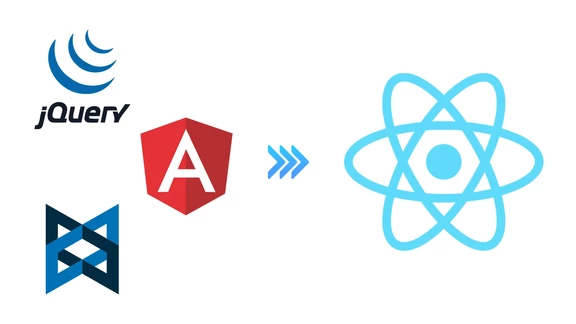
Legacy frontend migration to React
Outdated frontend frameworks, including legacy jQuery applications, unsupported SPA framework versions and ageing Create React App setups, slow releases and complicate hiring. A codebase audit and migration roadmap come first: a dependency inventory, a component inventory and a risk register.
Migration then proceeds in phased releases against a fixed checklist, keeping the application running throughout rather than a single cutover. Automated regression tests guard each phase, giving a clear pass/fail gate before every release.
Typical outcomes include removed end-of-life dependencies, a modern build toolchain (Vite or current webpack), and a smaller, better-performing bundle.
React use cases we deliver
Customer portals and self-service areas
Enterprise dashboards and data-heavy interfaces
Internal tools and back-office applications
Progressive web apps (PWA)
Enterprise e-commerce front-ends
Intranets and employee experience platforms
A React front-end on top of a Drupal intranet backend, designed for multilingual and multi-site deployments.

React on headless Drupal and enterprise integrations
A React front-end on a decoupled Drupal backend (JSON:API or GraphQL) gives marketing full editorial control while users get a modern experience. Multilingual content works out of the box, authored once and served to every locale, a pattern that matters for organizations running 20+ language variants.
Integration patterns Metadrop delivers include Salesforce, SAP, Oracle, HubSpot, Microsoft Dynamics, custom legacy REST/SOAP back-ends, and payment gateways, plus identity and SSO through SAML, OIDC and Keycloak.
Metadrop delivered React components as part of a multi-country Drupal platform for a global chemicals manufacturer operating in 60+ countries, spanning main, country and brand sites on a shared, component-based architecture. On a related engagement, Metadrop executed a platform split of a shared Drupal and React digital estate into two independent, separately branded platforms for two multinational specialty-chemicals organizations: sites, codebase, content and integrations were divided without interrupting either business.
Our React technology stack
- Language and framework: React (current stable), TypeScript, React Router, Vite.
- State management: Redux Toolkit, Zustand, TanStack Query, Context API.
- UI and design systems: Tailwind CSS, MUI, Radix UI; design tokens and bespoke component libraries.
- Testing: Vitest, React Testing Library, Playwright.
- Back-end pairing: Drupal (headless), Node.js, Next.js.
- Hosting and DevOps: AWS, Azure, Google Cloud; Docker, Kubernetes, GitLab CI, GitHub Actions.
- Mobile pairing: Ionic, Capacitor. See cross-platform apps using Ionic, React and Angular.
Security, compliance and governance
GDPR-ready React applications
WCAG 2.1 AA accessibility
NIS2-prepared delivery
ENS-certified partner
Front-end security baseline
Independent technical governance
How we work: our delivery process
Discovery and scoping
business goals, success metrics, technical constraints and an integration map, scoped before a line of code is written.Architecture and roadmap
a React architecture proposal, a migration plan if applicable, and a prioritized backlog ready for sprint zero.UX/UI design
a component library and key user flows designed before build, reducing rework. See UX/UI design services
Agile delivery in 2-week sprints
demos, retrospectives and a transparent backlog every sprint. See agile development methodology.
Quality, security and accessibility gates
automated tests, WCAG audits and dependency/CVE scans before each release.Launch and continuous improvement
production rollout, monitoring, performance budgets and ongoing maintenance under a defined SLA.
Engagement models
Dedicated team
Staff augmentation
Fixed-price project
Time and materials
Why organizations choose Metadrop for React
Metadrop brings 15+ years of enterprise web delivery across Drupal, React and decoupled architectures, working as an independent technical partner that owns the full lifecycle: strategy, UX/UI, build, maintenance and SLA-backed support. Metadrop is a Drupal Silver Certified Partner, ENS-certified, with a GDPR-, WCAG- and NIS2-ready delivery track record. It has delivered in 50+ countries, multilingual and multi-region by default, with the compliance credentials European enterprise procurement expects. Metadrop's own published engineering work on headless Drupal and JavaScript front-end architecture documents a decoupled-delivery practice that predates the current React tooling generation.
On one engagement, Metadrop built and maintained React components within a large multi-country Drupal platform for a global chemicals group across 60+ countries, including a WCAG accessibility audit and remediation delivered platform-wide. On another, Metadrop ran a Drupal 11 and dependency modernization program, including bot-driven traffic mitigation via CDN edge security, for a multinational industrial platform running React-based components alongside Drupal.
Frequently asked questions
What are React development services?
Consulting, design, build, migration, integration and long-term support for applications built with React, the open-source JavaScript library maintained by Meta. The scope spans SPAs, customer portals, dashboards, internal tools and progressive web apps.
React vs Angular vs Vue: which should we choose for an enterprise application?
React offers flexibility for teams that prefer to assemble their own stack around a library rather than an opinionated framework. Angular suits large, long-lived applications built around Google's opinionated, batteries-included framework and strict TypeScript conventions. Vue favors teams that want a gentler learning curve with strong templating ergonomics. Metadrop builds all three and advises based on team composition, governance needs and roadmap.
How long does it take to migrate a legacy frontend to React?
Most focused migrations run 3 to 9 months, depending on codebase size, test coverage and integration surface. A codebase audit in the first phase produces a project-specific estimate before any commitment.
How much does React development cost?
Cost depends on scope, integrations, team composition and engagement model. Metadrop publishes its engagement models (dedicated team, staff augmentation, fixed-price, time & materials) and quotes per project after a free consultation, rather than a public rate card, because rates vary by seniority and contract length.
Is React suitable for large-scale enterprise applications?
React is well suited to enterprise-scale applications when paired with TypeScript, a defined state-management strategy and a component architecture, the pattern Metadrop applies by default on enterprise builds. React's library-based model means governance and conventions are set deliberately at project start, rather than inherited from the framework.
Can React integrate with Drupal, Salesforce, SAP or our existing back-end?
Metadrop delivers React front-ends on Drupal headless backends as one of its established delivery patterns, and integrates routinely with Salesforce, SAP, Oracle, HubSpot, Microsoft Dynamics, custom REST/GraphQL APIs and SSO providers (SAML, OIDC, Keycloak).Are your React applications GDPR, WCAG and NIS2 ready?
GDPR-aligned data flows and WCAG 2.1 AA accessibility are part of the delivery baseline, with WCAG 2.2 AA applied as a design-quality target. Delivery is prepared for NIS2 requirements, and Metadrop is ENS-certified for Spanish public-sector contracts. Whether a given application meets these standards depends on the client's own scope and processing activities, so this is a technical readiness statement, not legal advice.What is the difference between React and React Native?
React builds web applications that run in the browser; React Native builds native mobile apps from a related component model. Metadrop's cross-platform mobile work (Ionic, React, Angular) is covered on a dedicated solution page.