
Next.js development services we provide
Custom Next.js application development
Metadrop builds net-new enterprise web applications and marketing sites on the Next.js App Router, including customer portals, dashboards and content-driven sites that need both interactivity and search visibility. Delivery uses TypeScript with a component architecture and a test suite in place from day one, not added later.
Next.js consulting and architecture review
An independent assessment covers rendering strategy (SSR, SSG, ISR), data-fetching patterns, bundle size and hosting architecture. The result is a clear roadmap delivered before any code changes, so the client decides with full technical visibility.
Migration to Next.js
Metadrop maps structured migration paths from a plain React SPA, Gatsby, WordPress or a legacy server-rendered stack onto Next.js. Migrations run in phased steps validated with automated regression tests at each stage, designed to minimize disruption to the live application and preserve existing search rankings rather than promising a risk-free switch.
Next.js + Drupal headless integration
Third-party integrations
Maintenance, support and SLA optimizatio
Long-term ownership covers security patching, dependency upgrades, performance tuning and feature evolution under a contractual SLA.
They've Trusted Metadrop
From global chemicals manufacturers to industrial, sports and humanitarian organizations, enterprises across 50+ countries have relied on Metadrop for React, Next.js and headless Drupal front-end delivery.






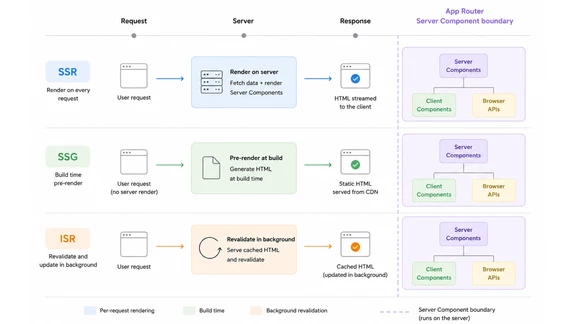
Rendering strategies: SSR, SSG, ISR and the App Router
Server-side rendering (SSR) renders each page on request, which suits personalized or frequently changing content that still needs to be indexable. Static site generation (SSG) pre-builds pages at deploy time, giving the fastest possible load for content that changes infrequently, such as marketing and product pages. Incremental static regeneration (ISR) re-generates static pages on a schedule or on demand, combining SSG's speed with content that needs periodic updates without a full rebuild.
The App Router, Next.js's current routing model, adds React Server Components, nested layouts and streaming, reducing the JavaScript shipped to the browser compared with the older Pages Router.
Rendering strategy is chosen per route based on content volatility and traffic pattern rather than applied uniformly across the whole site: a marketing landing page and a personalized dashboard typically use different strategies within the same Next.js application. Search engines index server-rendered and statically generated Next.js pages directly, addressing the common concern that a JavaScript front-end trades away SEO visibility.




Migrating to Next.js from React, Gatsby or a legacy stack
An outdated front-end, whether a plain React SPA with weak SEO, an unsupported Gatsby build, a slow WordPress theme, or a legacy server-rendered application, limits both search visibility and release speed.
A codebase and content audit comes first: route inventory, data-fetching patterns, third-party dependencies and a risk register specific to the codebase. Migration then proceeds in phased releases against a fixed checklist, route by route, keeping the existing site live throughout rather than a single cutover.
Automated regression tests and redirect mapping guard each phase, so indexed URLs and rankings are checked before and after each release rather than assumed to carry over. Typical outcomes include removed end-of-life dependencies, a rendering strategy matched to each route, and a smaller, better-performing bundle.
Migration is validated against production-equivalent test environments before cutover, designed to minimize disruption and preserve existing SEO signals rather than treating the switch as risk-free.
Next.js use cases we deliver
Marketing sites and content hubs with a headless CMS
Customer portals and self-service areas
Enterprise dashboards and data-heavy interfaces
Enterprise e-commerce front-ends
Internal tools and back-office applications
Intranets and employee experience platforms
A Next.js front-end sits on top of a Drupal intranet backend, built for multilingual and multi-site deployments.
Next.js on headless Drupal, and enterprise integrations
A Next.js front-end on a decoupled or progressively decoupled Drupal backend (JSON:API or GraphQL) gives marketing full editorial control while readers get server-rendered, search-indexable pages.
Multilingual content is authored once in Drupal and served to every locale through Next.js's internationalized routing, relevant for organizations running 20+ language variants.
Integration patterns delivered include Salesforce, SAP, Oracle, HubSpot, Microsoft Dynamics, custom legacy REST/SOAP back-ends, external mapping and geolocation services, and payment gateways. Identity and single sign-on cover SAML, OIDC, Keycloak.
Hosting is chosen to fit the client's infrastructure policy, whether Vercel, AWS, Azure, Google Cloud or a self-hosted Node.js/Docker deployment, so a Vercel-optimized build never becomes a Vercel-only dependency.
Metadrop delivered React front-end components and a headless-capable Drupal architecture for a global chemicals manufacturer operating in 60+ countries, spanning main, country and brand sites, later split into two independently branded platforms following a corporate spin-off.
Our Next.js technology stack
- Language and framework: Next.js (App Router and Pages Router), React (current stable), TypeScript.
- Data and state: TanStack Query, Redux Toolkit, Zustand, Server Actions.
- UI and design systems: Tailwind CSS, MUI, Radix UI; design tokens and bespoke component libraries.
- Testing: Vitest, React Testing Library, Playwright, Cypress.
- Back-end pairing: Drupal (headless and progressively decoupled), Node.js, GraphQL, REST.
- Hosting and DevOps: Vercel, AWS, Azure, Google Cloud; Docker, Kubernetes, GitLab CI, GitHub Actions.
- Mobile pairing: Ionic, Capacitor. See cross-platform apps using Ionic, React and Angular.
Security, compliance and governance
GDPR-ready Next.js applications
WCAG 2.1 AA accessibility
NIS2-prepared delivery
ENS-certified partner
Front-end security baseline
Independent technical governance
How we work: our delivery process
Discovery and scoping
business goals, success metrics, technical constraints and an integration map, scoped before a line of code is written.Architecture and roadmap
a Next.js rendering-strategy proposal (SSR, SSG or ISR per route), a migration plan if applicable, and a prioritized backlog ready for sprint zero.UX/UI design
a component library and key user flows designed before build, reducing rework. See UX/UI design services.
Agile delivery in 2-week sprints
demos, retrospectives and a transparent backlog every sprint. See agile development methodology.
Quality, security and accessibility gates
automated tests, WCAG audits, dependency and CVE scans, and Core Web Vitals checks before each release.Launch and continuous improvement
production rollout, monitoring, performance budgets and ongoing maintenance under a defined SLA.
Engagement models
Dedicated team
Staff augmentation
Fixed-price project
Time and materials

Why organizations choose Metadrop for Next.js
Metadrop brings 15+ years of enterprise web delivery across Drupal, React-based frameworks and decoupled architectures, working as an independent technical partner across strategy, UX/UI, build, migration and SLA-backed support.
Metadrop is a Drupal Silver Certified Partner and ENS-certified, with a GDPR-, WCAG- and NIS2-ready delivery track record. Delivery experience spans 50+ countries with routine multilingual and multi-region requirements, aligned with compliance requirements commonly encountered in European enterprise procurement.
Metadrop has published engineering work on headless Drupal and JavaScript front-end architecture, reflecting experience with decoupled architectures across multiple generations of front-end tooling.
Metadrop built and maintained React front-end components within a large multi-country Drupal platform for a global chemicals group operating across 60+ countries, including a platform later split into two independently branded platforms following a corporate spin-off.
Frequently asked questions
What are Next.js development services?
Next.js development services cover consulting, design, build, migration, integration and long-term support for applications built with Next.js, the React meta-framework. They span marketing sites, customer portals, dashboards, internal tools and e-commerce front-ends.
Is Next.js good for SEO?
Yes. Server-side rendering and static generation let search engines index fully rendered HTML rather than relying on client-side JavaScript execution, and rendering strategy is matched per route so content-heavy marketing pages get the fastest, most crawlable delivery.
What rendering strategy should we use: SSR, SSG or ISR?
SSG suits content that changes infrequently, such as marketing and product pages, for the fastest load times. ISR suits content that updates periodically without needing a full rebuild, such as a product catalogue or news listing. SSR suits personalized or frequently changing content that still needs to be indexable, such as account dashboards. Metadrop proposes a per-route mix as part of the architecture phase rather than a single strategy for the whole application.
How long does a migration to Next.js take?
Most focused migrations run 2 to 6 months, depending on codebase size, route count and third-party integration surface; pairing the migration with a new headless Drupal backend typically extends the timeline. A codebase and content audit in the first phase produces a project-specific estimate before any commitment.
How much does Next.js development cost?
Cost depends on scope, integrations, team composition and engagement model. Metadrop publishes its engagement models (dedicated team, staff augmentation, fixed-price, time and materials) and quotes per project after a free consultation, rather than a public rate card, because rates vary by seniority and contract length.Do we have to host our Next.js application on Vercel?
No. Next.js applications built by Metadrop deploy to Vercel, AWS, Azure, Google Cloud or a self-hosted Node.js/Docker environment, chosen to fit the client's existing infrastructure and procurement policy. Vercel-specific features, such as Edge Middleware, are used when they fit the brief rather than treated as a required dependency.Can Next.js integrate with Drupal, Salesforce or our existing back-end?
Yes. Metadrop delivers Next.js front-ends on Drupal headless and progressively decoupled backends as one of its established delivery patterns, and integrates routinely with Salesforce, SAP, Oracle, HubSpot, Microsoft Dynamics, custom REST/GraphQL APIs and SSO providers such as SAML, OIDC and Keycloak.Are your Next.js applications GDPR, WCAG and NIS2 ready?
GDPR-aligned data flows and WCAG 2.1 AA accessibility are part of the delivery baseline, with WCAG 2.2 AA applied as a design-quality target. Delivery is prepared for NIS2 requirements, and Metadrop is ENS-certified for Spanish public-sector contracts. Whether a given application satisfies these standards depends on the client's own scope and processing activities; this is a technical readiness statement, not legal advice.
Start your Next.js project with Metadrop
Metadrop delivers enterprise Next.js work covering architecture, build, migration and long-term SLA support.
Tell us about your application or migration and we'll scope a free 30-minute consultation, no commitment required, with a response within one business day.