
Drupal 7 reached end of life on 5 January 2025
The Drupal community's official support for Drupal 7 ended on 5 January 2025. Since that date, the community no longer issues security fixes, bug fixes or compatibility updates for Drupal 7 core or contributed modules. Any new vulnerability found in a Drupal 7 site now stays unpatched unless the site is covered by paid extended support.
The pressure builds from the infrastructure side too. Hosting providers and PHP versions are progressively dropping support for Drupal 7 environments, so the cost of standing still keeps rising. It helps to plan against the wider release calendar: Drupal 10 reaches end of life on 9 December 2026, Drupal 11 is the current recommended target, and Drupal 12 is expected in December 2026.
Interim security support while you plan your migration
Some sites cannot migrate immediately, whether because of budget cycles, competing priorities or the size of the platform. For those cases, Metadrop provides interim security support as a temporary bridge to a supported version, meant to buy time while the migration is scoped and delivered.
The service covers monitoring and patching of known vulnerabilities in Drupal 7 core and in the contributed and custom modules your site actually uses. It is backed by a contractual SLA for response and resolution times, so cover is a written commitment rather than an informal, best-effort arrangement.
This keeps the current site running securely while the move to Drupal 10 or 11 proceeds in parallel, which gives a team that is not ready yet an entry point instead of a hard deadline. Teams look for this under different names: extended support, long-term support (LTS) or lifetime support. The intent behind each is the same, to stay protected during the transition.
Not ready to migrate yet? Keep your Drupal 7 site patched and SLA-covered while we scope the move to Drupal 10 or 11 at your pace.

Why staying on Drupal 7 is now a risk
The clearest risk is security exposure. Once core and modules stop receiving patches, an unsupported site becomes a target for known, published exploits that are no longer fixed upstream.
Compliance is close behind, and here the reading is an interpretation, not legal advice. Running unsupported software can place in-scope organizations in breach of security-of-processing obligations under GDPR and of sector-specific rules. Under NIS2, operators classed as essential or important entities are increasingly expected to run supported, patched software, and migrating puts a platform in a position to be prepared for NIS2 requirements. Accessibility matters too: WCAG 2.1 AA is today's legal accessibility baseline in the EU, and a migration is the natural moment to build it in, while a full revamp can design beyond it. Metadrop's engineers have published technical guidance on the digital-accessibility legal obligations taking effect in 2025 and on preparing for the European Accessibility Act.
There is a cost argument as well. As modules, tools and qualified Drupal 7 developers thin out, even small fixes get slower and more expensive. Unsupported platforms also carry a higher chance of unplanned downtime and data-integrity incidents, which turns a deferred migration into an operational liability.
Which migration path fits your needs
There are two migration routes, and Metadrop settles which one fits during the free pre-analysis, based on your goals and budget.
Direct upgrade: move to a supported platform, keep the site as-is
A direct upgrade suits teams that want speed and minimal change. It starts with a full audit of the current Drupal 7 site, then moves content, users and files to Drupal 10 or 11 through a mix of automated and manual migration. Custom modules and integrations are rebuilt or ported for compatibility, and the URL structure, redirects and metadata are carried over to protect existing SEO equity. Quality assurance runs on Behat, BackstopJS and static analysis, with final testing before cutover. The outcome is a supported, secure platform that keeps its current look and features.
Migration + revamp: modernize while you migrate
A migration plus revamp treats end of life as the moment to modernize. It includes everything in the direct upgrade and adds a discovery phase with your stakeholders, then a new architecture, navigation and UX, with accessibility improvements built in against the WCAG 2.1 AA baseline. Custom modules are redeveloped rather than ported, and the content model is simplified wherever that reduces long-term maintenance. Editors get training on the new tools and workflows. The outcome is a modern platform that also significantly reduces the technical debt carried since Drupal 7.
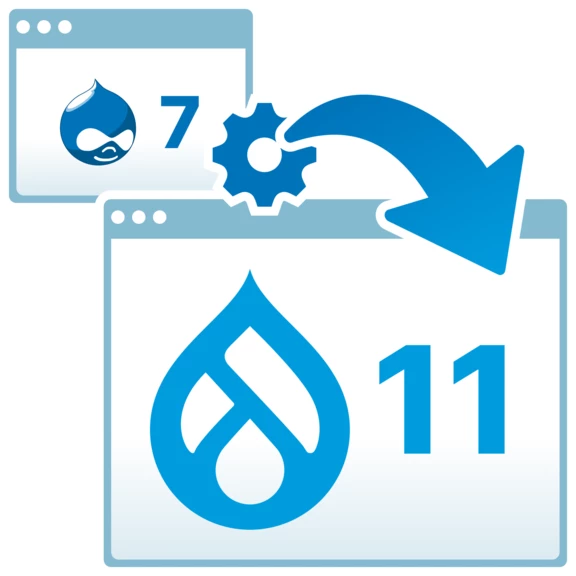
How we migrate your Drupal 7 site
Every engagement starts with a free pre-analysis of the current site: content volume, custom code, integrations and the risks specific to your platform. From there, Metadrop builds a phased plan with a timeline and milestones, so the live site stays covered throughout the work.
The migration itself is built on Drupal core's Migrate, Migrate Drupal and Migrate Drupal UI, with Upgrade Status to check module readiness, using Drush and DDEV in local environments. The target stack is Drupal 10 or 11 on PHP 8.3+ (Drupal 11's baseline), with Symfony components, Twig, CKEditor 5 and the Claro and Olivero themes. Each migration is validated on a test environment before cutover, a step designed to preserve content, users and files and to minimize downtime, and every phase comes with transparent reporting on status and risks. Metadrop's engineers have published technical write-ups on updating Drupal to PHP 8 and on migrating Drupal databases from MySQL 5.7 to MySQL 8.
Metadrop has run this process at scale. On one engagement it migrated a multinational building-materials manufacturer, with operations across dozens of countries, from Drupal 7 to Drupal 9, refactoring the architecture along the way: 5,700 content items migrated and content types reduced from 20 to 6, then upgraded onward to Drupal 10 and Drupal 11 as each version's end of life approached. On another, it migrated a global humanitarian organization from Drupal 7 to Drupal 10, carrying donation processing, member management and a Salesforce CRM integration into the new platform.
Why Metadrop
Metadrop has spent 15+ years focused on Drupal and is a Drupal Silver Certified Partner, with more than 100 modules contributed back to the Drupal community. The team is ENS certified and has a delivery track record against GDPR, WCAG and NIS2 requirements, working across 50+ countries and 30+ languages.
Every migration runs through automated and manual testing, using Behat, BackstopJS and static analysis. After launch, maintenance and support keeps the new platform patched and current, so the move to Drupal 10 or 11 is the start of a supported lifecycle rather than a one-off project.
They've Trusted Metadrop
From industry and NGOs to public administration, organizations across Europe have relied on Metadrop to move mission-critical Drupal platforms off legacy versions and keep them secure.








Drupal 7 migration FAQ
When did Drupal 7 reach end of life?
Drupal 7 reached end of life on 5 January 2025, when the Drupal community stopped issuing security and bug fixes. From that point, ongoing protection comes only from paid interim or extended support, or from migrating to a supported version.
Can we keep running Drupal 7 safely for now?
Interim security support monitors and patches known vulnerabilities under a contractual SLA, which keeps a site protected in the short term. It is a temporary bridge that buys time until the migration is delivered, rather than a lasting substitute for migrating.
How long does a Drupal 7 migration take?
Timescales depend on content volume, the number of custom modules and the integrations involved. Metadrop provides a grounded estimate after the free pre-analysis, broken into phased milestones you can track.
How much does a Drupal 7 migration cost?
Cost is driven by scope: the number of content types, the amount of custom code, the integrations, and whether you choose a direct upgrade or a revamp. A **fixed-scope quote** follows the pre-analysis, and the pre-analysis itself is free and carries no obligation.Will we lose content, data or SEO rankings?
The process is designed to preserve content, users and files, and it is validated on a test environment before cutover. URL structure, redirects and metadata are carried over to protect existing SEO equity.
What happens to our custom modules and integrations?
Each custom module is audited, then rebuilt or replaced for Drupal 10 or 11 compatibility. Third-party integrations, from CRM and ERP to payment and search, are reconnected on the new platform.
Does migrating help with GDPR, NIS2 and accessibility?
A supported, actively patched platform supports security-of-processing expectations, which is an interpretation rather than legal advice. The result can be prepared for NIS2 requirements, and WCAG 2.1 AA, today's legal accessibility baseline, can be built in during a revamp.
Can we redesign during the migration?
Yes. The migration plus revamp path plans new architecture, UX and features, while a direct upgrade keeps the current look and feel unchanged.
Start your Drupal 7 migration
Book a free pre-analysis and action plan: Metadrop reviews your Drupal 7 site and outlines both interim security support and a migration path to Drupal 10 or 11. There is no commitment; you receive the plan and a fixed-scope estimate, and a specialist typically responds within one business day.