


What is managed Drupal hosting on AWS?
Managed Drupal hosting on AWS means Drupal runs on Amazon Web Services infrastructure, typically EC2 compute, RDS for the database, and S3 for file storage, all provisioned inside the client's own AWS account rather than a third-party platform's shared infrastructure.
Metadrop designs the architecture, migrates the platform, and takes on ongoing DevOps management, so the client keeps account ownership without running AWS operations alone. That's different from managed PaaS options, where a platform vendor operates its own infrastructure: here, the client retains direct control of the AWS account, its billing, and its compliance boundary.
The approach suits organizations that already have an AWS relationship, an enterprise agreement, reserved capacity, or existing workloads, and want Drupal running inside that same account rather than migrated to a separate vendor.
Why host Drupal on AWS with Metadrop
With Drupal on AWS, the client keeps ownership of the AWS account: billing, reserved-instance commitments, and any existing enterprise agreement stay under the client's control rather than moving to a third-party platform's contract. Infrastructure cost tracks actual usage through AWS's own pricing model, sized to the platform's real traffic instead of a fixed tier.
This setup fits organizations consolidating cloud spend under one AWS relationship, moving off an end-of-support host, or responding to a failed compliance audit, all recurring reasons teams start evaluating AWS. Metadrop has delivered AWS-hosted infrastructure, including EC2 compute and S3 object storage, for a large Southern European digital media group running multiple country platforms.
Metadrop has also published its own technical analysis of a complex Drupal cloud-migration architecture, documenting the trade-offs involved in moving a large platform onto a cloud infrastructure account.
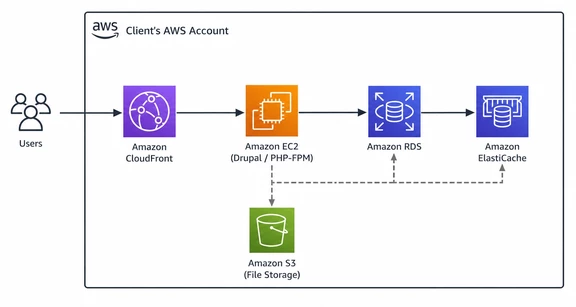
Our Drupal on AWS architecture & stack
Metadrop sizes EC2 compute instances to the platform's traffic profile and configures them for Drupal's PHP-FPM and web-server requirements. RDS is the managed database layer, cutting the manual database-administration work a self-managed instance would need, while S3 handles file and media storage, keeping static assets separate from the application servers.
CloudFront is the CDN layer, serving cached content from edge locations to speed up page loads for visitors around the world. ElastiCache (Redis) sits in front of the database as an in-memory cache layer, moving regenerable cache tables into memory so traffic spikes don't hit the database as hard.
Infrastructure is provisioned as code, typically with Terraform or an equivalent tool, so environments stay reproducible and every change is reviewed before it reaches production.
Autoscaling & performance for traffic spikes
AWS Auto Scaling groups add or remove EC2 capacity based on real-time load, designed to absorb traffic spikes without manual intervention. A load balancer spreads traffic across the current set of instances, so scaling out doesn't require a maintenance window.
Caching layers, CloudFront's edge cache, ElastiCache/Redis, and Drupal's own page cache, cut how much traffic reaches the database and application servers in the first place, lowering how much raw compute a spike actually requires. Autoscaling rules and instance sizing are configured per platform, based on the client's own traffic history and expected peak events such as product launches, press coverage, or seasonal campaigns.
Ongoing monitoring flags capacity trends before they turn into incidents, rather than reacting only after a spike has already caused slowdowns.



Security, compliance & shared responsibility on AWS
AWS operates under a shared-responsibility model: AWS secures the underlying cloud infrastructure, while the account holder is responsible for the operating system, the application, and the data configured on top of it. Metadrop configures and manages the client-side half of that boundary, including server hardening, access controls, patching, and Drupal-specific security configuration, as part of the managed DevOps service.
Metadrop holds ENS certification and has a delivery track record against GDPR, WCAG, and NIS2 requirements, applied to the client's own AWS account rather than inherited from a shared platform. Network configuration, including VPC segmentation, security groups, and encrypted storage, is scoped to the platform's own compliance requirements rather than a one-size-fits-all default.
Whether a specific regulation applies to a given organization's AWS setup is an interpretation of the requirements, not legal advice. Metadrop provides the technical translation.
Migrating to AWS without disrupting your platform
An audit of the current stack, traffic profile, and integrations scopes the target AWS architecture before any migration work starts. Data, files, and configuration then move into a production-identical AWS environment for validation before cutover.
A planned cutover window keeps disruption to a minimum, with a rollback path available if issues surface during the move. Migration timelines vary with platform size and integration complexity, so Metadrop scopes them during the initial audit rather than quoting a fixed figure upfront.
Metadrop has also published its own technical analysis of a complex Drupal cloud migration, documenting the architecture decisions and challenges involved in this kind of move.
They've Trusted Metadrop
From digital media groups to global enterprise and public-sector platforms, organizations across Europe have relied on Metadrop for Drupal hosting and DevOps, including on AWS.
Metadrop ran EC2 compute and S3 object storage for a large Southern European digital media group's multi-country news platform (three main country sites plus 14 subsites), alongside successive Drupal core upgrades.





Why Metadrop for Drupal on AWS
Metadrop brings 15+ years of Drupal delivery and Drupal Silver Certified Partner status to cloud infrastructure work as well as managed platforms. That experience spans an international reach: infrastructure and platforms delivered across 50+ countries and 30+ languages, including multi-country and multilingual architectures.
Metadrop's technical governance is independent: architects advise directly on AWS architecture and sizing decisions, rather than defaulting to a fixed template regardless of the platform's actual traffic and compliance needs.
AWS hosting and DevOps are quoted per engagement, scoped to the client's traffic, compliance requirements, and existing AWS setup rather than a fixed tier. A discovery call produces a written proposal.
Frequently asked questions
What is managed Drupal hosting on AWS?
Drupal running on Amazon Web Services, typically EC2, RDS, and S3, provisioned inside the client's own AWS account. Metadrop designs the architecture, migrates the platform, and manages it going forward as a DevOps service. That's different from a managed PaaS, where a platform vendor rather than the client owns the hosting account.What AWS services do you use to host Drupal?
EC2 handles compute, RDS is the managed database layer, and S3 stores files and media. CloudFront is the CDN layer and ElastiCache (Redis) is the in-memory cache layer, with infrastructure provisioned as code so environments stay reproducible across changes.What are the benefits of hosting Drupal on AWS?
The client keeps ownership of the AWS account, its billing, and any existing enterprise agreement. Infrastructure cost tracks actual usage rather than following a fixed platform tier, and the full breadth of AWS services, autoscaling, a managed database, a CDN, and caching, stays available inside one account.How much does Drupal hosting on AWS cost?
Pricing is set per engagement, scoped to traffic volume, architecture complexity, and the client's existing AWS setup, rather than a fixed tier, since AWS instance sizing and the services used vary by platform. A discovery call produces a written, scoped proposal covering both AWS infrastructure costs and Metadrop's DevOps service.How long does it take to migrate a Drupal site to AWS?
Timeline depends on platform size, integration complexity, and data volume, and Metadrop scopes it during an initial audit rather than quoting a fixed figure upfront. Data, files, and configuration are validated in a production-identical AWS environment before cutover, and a planned cutover window keeps disruption to a minimum, with a rollback path available.Does Drupal on AWS autoscale automatically during traffic spikes?
Once configured for the platform, AWS Auto Scaling groups add or remove compute capacity based on real-time load. Caching layers, CloudFront, ElastiCache/Redis, and Drupal's own page cache, cut how much traffic reaches the database in the first place, and autoscaling rules and instance sizing are set per platform based on the client's own traffic history.Who is responsible for security on our AWS account?
AWS secures the underlying cloud infrastructure; the account holder is responsible for the operating system, the application, and the data running on top of it. Metadrop configures and manages that client-side half, server hardening, access controls, patching, and Drupal-specific security, as part of the DevOps service. Whether a specific regulation applies to a given AWS setup is an interpretation of the requirements, not legal advice.